New Phoenix Rowhammer Attack Bypasses On-Die ECC in SK Hynix DDR5 Modules
Researchers from ETH Zurich and Google have uncovered a significant vulnerability in SK Hynix DDR5 memory modules, demonstrating that even modules equipped with on-die ECC (Error-Correcting Code) remain susceptible to a new Rowhammer attack variant named Phoenix (CVE-2025-6202). This advanced attack can be executed in just 109 seconds, highlighting its practical threat to modern computing environments.
Understanding the Phoenix Rowhammer Variant
The research team reverse engineered the built-in DRAM mitigation known as Target Row Refresh (TRR), which is designed to counteract traditional Rowhammer exploits. Their analysis revealed a critical blind spot in the refresh-sampling logic: the sampling period repeats every 128 tREFI intervals, and within each cycle, the first two of four sub-intervals are only lightly sampled. This oversight creates an opportunity for attackers to bypass existing protections.
Leveraging this vulnerability, the researchers developed two innovative hammering patterns: a concise 128-tREFI pattern and an extended 2608-tREFI pattern. They further enhanced the attack with a self-correcting refresh synchronization method, allowing Phoenix to maintain precise alignment across thousands of refresh intervals. This advancement overcomes limitations seen in previous techniques, such as Zenhammer, which struggled with reliable synchronization.
Real-World Impact and Attack Effectiveness
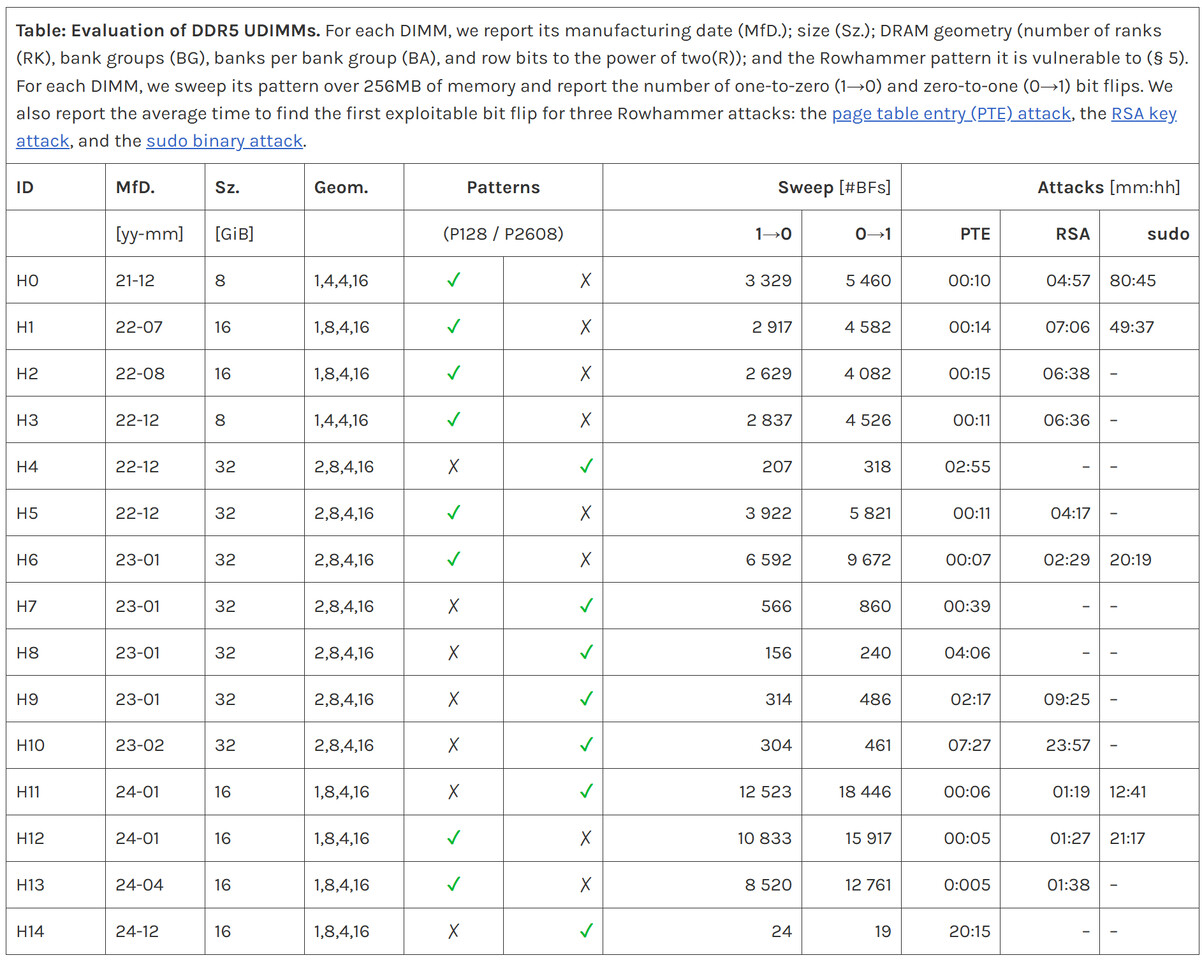
The team tested 15 SK Hynix DDR5 modules manufactured between late 2021 and late 2024. Every module experienced bit flips under at least one of the two hammering patterns, with the 128-tREFI pattern proving approximately 2.62 times more effective on average. Thousands of bit flips were observed per DIMM, which the researchers translated into practical attack primitives. These included:
- Page-table corruption, enabling arbitrary read and write access
- Extraction of RSA-2048 private keys from co-located virtual machines
- Local privilege escalation by corrupting critical binaries such as
sudo
To maximize the likelihood of targeting a vulnerable refresh offset—only 2 out of 128 offsets (1.56%) are susceptible—the researchers ran four shifted pattern instances in parallel across each of the four memory banks. This approach increased the probability of a successful attack to approximately 25%.
Mitigation Strategies and Industry Response
As a temporary mitigation, the researchers tested tripling the DRAM refresh rate (with tREFI intervals of roughly 1.3 μs), which successfully prevented Phoenix-induced bit flips in their test environment. However, this solution incurs a performance overhead of up to 8.4% on SPEC CPU2017 benchmarks. The team also highlighted the importance of BIOS and firmware updates as immediate countermeasures. Their responsible disclosure prompted collaboration with SK Hynix, CPU manufacturers, and cloud service providers, resulting in mitigations such as a BIOS update for AMD systems announced during the embargo period.
To support the broader community, the researchers released artifacts and a proof-of-concept tool on GitHub, enabling administrators to assess the vulnerability of their own DDR5 modules. They emphasize that this code is intended solely for diagnostic purposes and not for exploitation.
The discovery of the Phoenix Rowhammer variant underscores the ongoing challenges in securing modern DRAM against sophisticated memory attacks, even as new hardware-level protections are introduced. Continued collaboration between hardware vendors, researchers, and the security community remains essential to address these evolving threats.